Meraki Wi-Fi 6E vs Wi-Fi 7 Access Points
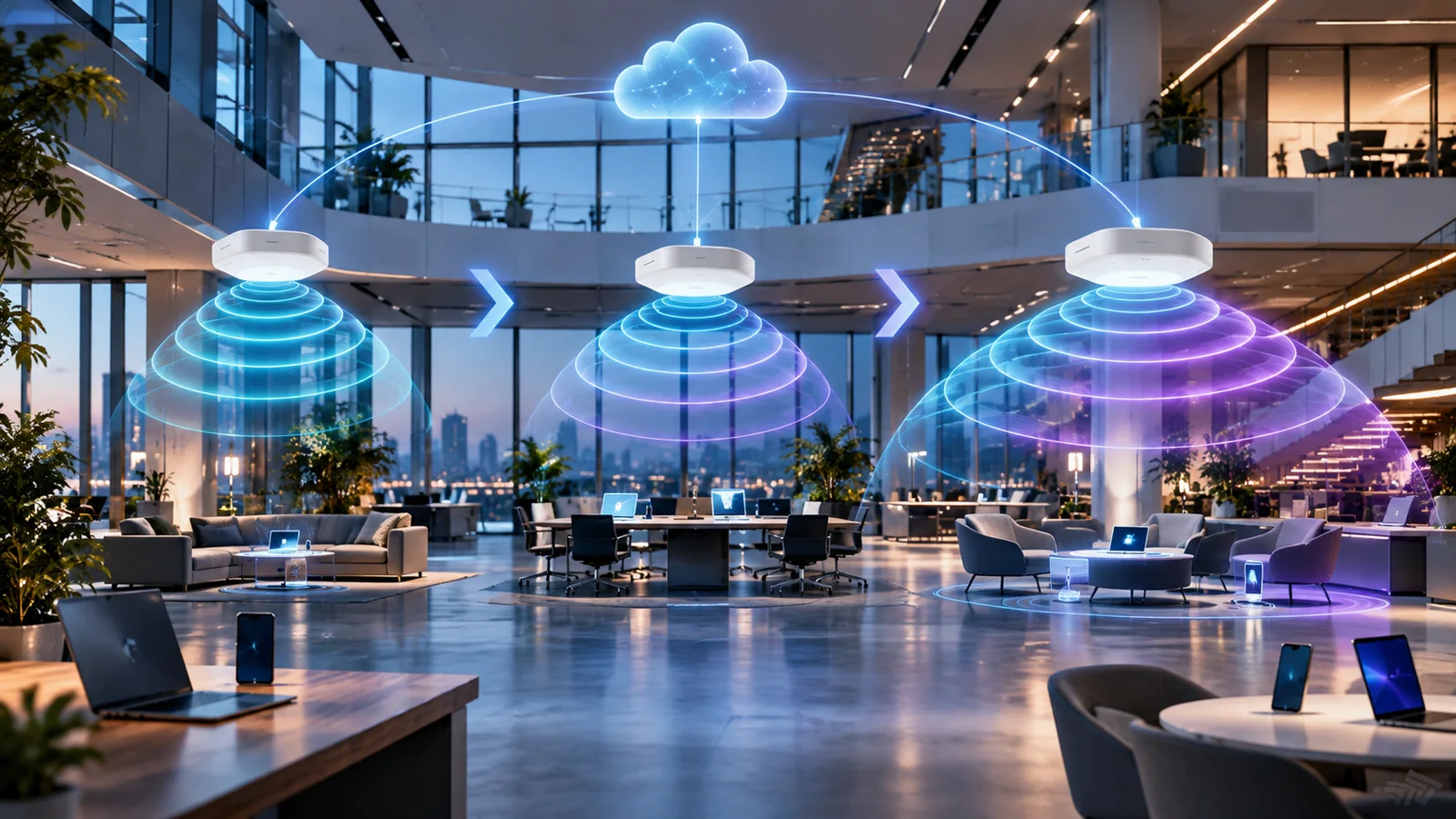
Compare Meraki-managed Wi-Fi 6E and Wi-Fi 7 access points, including CW9160 and CW9170 families, by radios, uplinks, power, clients and deployment fit.
Key Points
- Wi-Fi 7 adds capabilities such as Multi-Link Operation and 320 MHz channels, but client support, spectrum rules and wired infrastructure determine the real benefit.
- CW9160 Wi-Fi 6E models remain sensible for mainstream enterprise deployments that need 6 GHz without paying for maximum Wi-Fi 7 capacity.
- CW9172 targets lower-density or hospitality-style locations, while CW9176 and CW9178 serve progressively higher performance and density requirements.
- A Wi-Fi 7 refresh often exposes hidden switch-port, PoE and cabling constraints before it exposes a radio limitation.
- Cloud management and licensing must be included in the bill of materials for every managed AP.
Meraki-managed wireless has moved from the familiar MR naming scheme into a unified Cisco Wireless portfolio that includes CW9160 Wi-Fi 6E and CW9170 Wi-Fi 7 access points. The result is more choice, but also more ways to overspend. This guide compares Wi-Fi 6E and Wi-Fi 7 for Meraki dashboard deployments and maps the major AP families to real purchasing decisions.
Wi-Fi 6E vs Wi-Fi 7: What Actually Changes?
Wi-Fi 6E extends Wi-Fi 6 into the 6 GHz band. That gives compatible clients cleaner spectrum and more channel capacity than a 2.4/5 GHz-only design. Wi-Fi 7 keeps 6 GHz and adds tools intended to increase throughput, reduce latency and use spectrum more flexibly, including Multi-Link Operation, wider 320 MHz channels and 4K QAM.
Those features do not create an automatic two-generation jump for every user. A Wi-Fi 6 client cannot use Wi-Fi 7-only features, and a country's regulatory rules determine how much 6 GHz spectrum and power are available. In normal offices, good AP placement, channel planning and sufficient wired capacity may produce a larger improvement than selecting the top radio configuration.
| Decision | Wi-Fi 6E | Wi-Fi 7 |
|---|---|---|
| Best fit | Mainstream 6 GHz refresh | New high-performance or long-life deployment |
| Client reality | Broad Wi-Fi 6/6E fleet | Growing Wi-Fi 7 client population |
| Peak channel width | Up to 160 MHz | Up to 320 MHz where supported |
| Key new capability | Access to 6 GHz | Multi-Link Operation and higher spectral efficiency |
| Infrastructure pressure | Often 2.5/5 GbE plus higher PoE | Can justify 5/10 GbE and larger PoE budgets |
Check Client and Spectrum Readiness First
Inventory the client fleet by wireless generation, supported bands, security capability, and replacement schedule. Separate managed laptops and phones from scanners, printers, building systems, medical devices, and other long-lived clients. A new AP remains backward compatible with many older devices, but those clients cannot use 6 GHz or generation-specific features and may still consume airtime on 2.4 or 5 GHz.
Six-gigahertz access has security and discovery implications. Confirm that identity, certificates, WPA3 policy, onboarding, and driver versions work with the target client population. Test the actual device models used by executives, voice users, operational teams, and critical applications. A procurement list that says only "Wi-Fi capable" is not detailed enough for a 6 GHz migration.
Regulatory rules vary by country and can affect available channels, transmit power, indoor or outdoor use, and automated frequency coordination requirements. Use the correct regional SKU and current Cisco regulatory documentation for every deployment location. Do not copy a channel plan or expected coverage from one country to another without verification.
Estimate when compatible clients will become the majority. If most endpoints will remain on 5 GHz for several years, improving placement and channel reuse may provide more value than buying the highest radio tier. If the organization is beginning a long building lifecycle with a rapidly changing client fleet, newer hardware may avoid an early second refresh.
Meraki-Managed AP Model Families
The CW9162, CW9164 and CW9166 are indoor Wi-Fi 6E options that scale from cost-conscious general coverage to higher-performance deployments. CW9163E provides external antennas for spaces that need purpose-designed coverage. MR57 is another high-performance Wi-Fi 6E option in the Meraki portfolio.
For Wi-Fi 7, Cisco documentation lists models including CW9172I and CW9172H for general or hospitality-style deployments, CW9176 variants for high performance, and CW9178I for ultra-high performance and density. Cisco's Wi-Fi 7 collateral describes CW9176 as a 12-spatial-stream tri-band AP with a 10 Gbps interface, while CW9178 increases radio capacity and provides dual 10 Gbps connectivity. Those uplinks are capability ceilings, not a statement that every office will generate 10 Gbps of useful wireless traffic.
| Family | Relative position | Typical use |
|---|---|---|
| CW9162 / CW9164 | Mainstream Wi-Fi 6E | Offices, classrooms and general enterprise coverage |
| CW9166 / MR57 | High-performance Wi-Fi 6E | Higher density and demanding client populations |
| CW9172I / CW9172H | Entry/mainstream Wi-Fi 7 | General coverage, rooms, hospitality and compact sites |
| CW9176I / CW9176D1 | High-performance Wi-Fi 7 | Modern campuses and dense collaboration spaces |
| CW9178I | Ultra-high-performance Wi-Fi 7 | Very dense venues and maximum-capacity designs |
When Wi-Fi 6E Is the Better Buy
Choose Wi-Fi 6E when the project needs 6 GHz capacity now but the client fleet is mostly Wi-Fi 6 or 6E, the refresh cycle is shorter, or the access switching cannot economically support the power and uplink requirements of higher-end Wi-Fi 7 APs. Wi-Fi 6E is also a strong value in offices where the limiting factor is RF contention rather than extreme per-client throughput.
Pricing can make this decision straightforward. Compare current CW9160 and MR SKUs on https://globalpricelist.com/meraki with the required cloud license, mounting accessories and power. A discounted high-end Wi-Fi 6E model may deliver more usable capacity than an entry Wi-Fi 7 AP at a similar project cost.
When Wi-Fi 7 Is Worth It
Wi-Fi 7 is easier to justify for a new building, a five-to-seven-year refresh, a dense client environment, or workloads that are sensitive to latency and consistency. It also makes sense where the organization is buying Wi-Fi 7 laptops and mobile devices at scale and has already standardized on multigigabit access switching.
Do not buy the highest model simply because it is newest. CW9172 can be the better choice for many rooms and branches, while CW9176 and CW9178 are aimed at progressively more demanding environments. External or directional antenna variants should be selected from an RF design, not used as a generic upgrade.
RF Design and Capacity Planning
Begin with requirements for coverage, client density, application demand, roaming, location services, and resilience. A predictive design should use accurate floor plans, wall materials, ceiling heights, antenna patterns, and permitted power levels. Validate it with an onsite survey where the environment is complex or business-critical. The quantity of APs should come from capacity and signal requirements, not from a fixed square-foot rule.
Wider channels increase peak throughput but reduce the number of reusable channels. In dense offices, classrooms, or venues, narrower channels can produce better aggregate capacity and more predictable roaming. The availability of 6 GHz creates more planning flexibility, yet the right width still depends on client support, interference, and cell density. A 320 MHz channel is a capability, not a default design choice.
Model each band separately. Two-gigahertz service may remain necessary for legacy or IoT devices, while modern clients can prefer 5 or 6 GHz. Establish minimum data rates and band-steering policy carefully so older clients are not stranded. Validate voice and real-time applications across cell boundaries rather than judging the design only from stationary speed tests.
High-density spaces need capacity calculations based on concurrent active clients and application demand. Auditorium seating count alone overstates simultaneous traffic, while an exam room, trading floor, or design studio may create unusually high demand per user. Include uplink oversubscription and internet or WAN capacity so a fast WLAN does not simply move the bottleneck upstream.
Switching, PoE and Cabling Requirements
A wireless refresh is also a wired-edge project. Check the negotiated Ethernet speed, PoE class, available switch power budget and cable plant for every AP location. A 10 GbE-capable AP connected to a 1 GbE switch port will operate, but the uplink can become the bottleneck. Likewise, an AP that cannot obtain its preferred PoE level may disable radios or features depending on the model and configuration.
Budget for the complete path: AP, mount, license, access switch, optics if applicable, UPS capacity and cabling remediation. If access switching also needs replacement, compare the combined project against the expected client demand rather than treating wireless and switching as separate purchases.
Check power at the full switch or stack level, not just per port. The access switch may support the required PoE class on a port while lacking enough aggregate budget to power every planned AP and camera simultaneously. Confirm power-supply quantity, redundancy mode, cable length and quality, and behavior when an AP receives less than its preferred power. Include growth and a failed power-supply scenario where availability matters.
Existing cable should be tested against the required Ethernet rate rather than accepted from its category label alone. Termination quality, bundles, distance, and prior damage can prevent a link from negotiating at the expected speed. Remediating cabling after AP installation adds delay and can make a radio problem appear to be a network problem.
Licensing and Day-Two Operations
Include an active cloud entitlement for every managed AP and normalize all alternatives to the same term. Confirm the organization's licensing model, edition, renewal date, and any feature dependencies before purchase. Hardware MSRP by itself does not represent the cost of a functioning managed deployment; the Meraki licensing guide covers term and renewal planning.
Define dashboard networks, configuration templates, administrator roles, alert ownership, firmware policy, and maintenance windows before mass onboarding. Templates reduce repetitive work but can also distribute an incorrect RF, VLAN, or firewall setting to many locations. Use peer review and a representative pilot group for material changes.
Plan integrations for identity, guest access, location analytics, APIs, syslog, and the service desk. Decide how long troubleshooting and client data must be retained and who may access it. Tune alerts so each actionable event has an owner; sending every condition to a shared inbox usually creates noise rather than faster resolution.
Keep an inventory linking serial number, AP name, location, switch port, cable record, mount, license, support status, and renewal date. That record shortens replacement time and makes it possible to verify whether installed hardware still matches the design after moves and renovations.
Wi-Fi Migration Checklist
- Inventory client support for 6 GHz, WPA3 and Wi-Fi 7.
- Confirm local 6 GHz regulations and channel availability.
- Run an RF design for coverage, capacity and antenna selection.
- Map every AP to switch-port speed, PoE budget and cable category.
- Confirm the Meraki dashboard license type and term.
- Pilot roaming, voice, location and IoT integrations before a broad rollout.
- Use measured client experience, not only speed tests, to validate the design.
If the wireless refresh is paired with a security-edge refresh, the Meraki MX comparison helps align the branch firewall with the new WLAN capacity.
Pilot and Validation Plan
Select a pilot area that represents common walls, client types, applications, and access switching without putting the most critical site first. Validate onboarding, authentication, DHCP and DNS, roaming, voice, guest access, IoT devices, location services, and normal failure scenarios. Test during realistic occupancy; an empty-building survey cannot prove high-density capacity.
Measure service-level indicators such as connection success, authentication time, DHCP time, roaming reliability, latency, loss, retransmissions, and application performance. Compare results by client generation and band. A single close-range throughput test does not reveal whether users can connect consistently throughout the building.
Test operational workflows as well: replace an AP, move it between switch ports, roll firmware forward and back where supported, apply a template change, and confirm alerts reach the right team. Record acceptance thresholds and unresolved exceptions. Expand in waves only after both user experience and support processes meet the agreed criteria.
After rollout, review band distribution, channel use, power, wired negotiation rates, client capability, and incident trends. Adjust configuration from evidence rather than copying every pilot setting unchanged. The best model choice still needs a maintained RF design and disciplined operations to deliver value over its full lifecycle.
Keep a dated acceptance package with floor plans, survey results, AP locations, antenna orientation, channel and power policy, switch-port mappings, cable-test results, license records, and known exceptions. When furniture, walls, client mix, or application demand changes, compare the new environment with that baseline before adding hardware. This prevents gradual design drift from being mistaken for a product limitation.
Schedule periodic health reviews that combine cloud telemetry with user and service-desk evidence. Look for repeated authentication delays, sticky clients, overloaded cells, unused radios, power negotiation issues, and uplink errors. Revisit alert thresholds and firmware policy as the deployment matures. A successful refresh is not the day every AP comes online; it is a network that continues to meet measurable coverage, capacity, roaming, and operational goals as clients and sites change.
Use the same acceptance criteria for later sites so deployment quality stays consistent. Document justified exceptions, assign an owner, and set a review date. Repeatable evidence makes model choices easier to defend and prevents a premium AP from being used as a substitute for survey, cabling, or configuration work.
Sources
- Cisco Wireless AP Generations and Standards - Cisco Meraki Documentation
- CW9176I Installation Guide - Cisco Meraki Documentation
- Unified Licensing for Wi-Fi 7 APs - Cisco Meraki Documentation
FAQ
Is Wi-Fi 7 always faster than Wi-Fi 6E?
Wi-Fi 7 has a higher capability ceiling, but real performance depends on client support, spectrum, channel plan, wired uplink, PoE and RF conditions. A well-designed Wi-Fi 6E network can outperform a poorly designed Wi-Fi 7 deployment.
Which Meraki Wi-Fi 7 AP is best for an office?
CW9172 can fit mainstream rooms and branches, while CW9176 targets higher performance and CW9178 targets ultra-high density. The right model comes from a capacity and RF design, not office size alone.
Do Meraki Wi-Fi 7 APs need multigigabit switches?
They can operate at lower negotiated speeds, but multigigabit ports are often needed to avoid constraining aggregate capacity. Check the exact AP data sheet, switch port and cabling before purchase.
Does 6 GHz work in every country?
No. Available channels, power levels and outdoor use vary by regulatory domain. Confirm the rules and the correct regional SKU for every deployment country.
Do Meraki-managed APs require licenses?
Yes. Include the appropriate Meraki or Cisco Networking subscription and term in the bill of materials for each managed AP.
Check Current Meraki Pricing
Browse the full, daily-updated Meraki GPL on GlobalPriceList.com.
View Meraki Price List