
HPE Networking AP-723H: Dual-Platform Wi-Fi 7 Guide
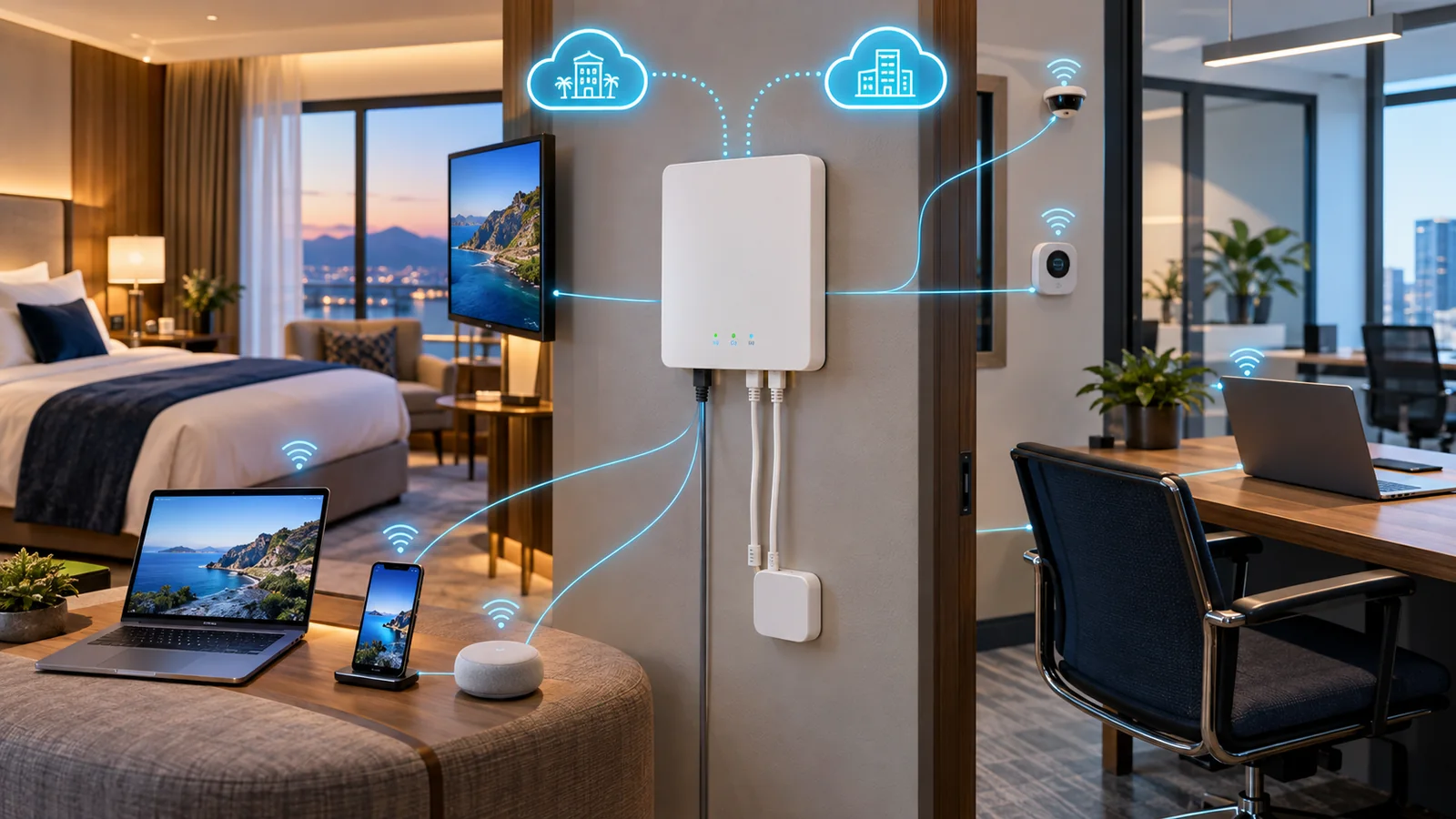
Understand the HPE Networking AP-723H Wi-Fi 7 hospitality access point, including Aruba Central or HPE Mist management, radios, ports, PoE and deployment fit.
Key Points
- AP-723H is a tri-band 2x2 Wi-Fi 7 hospitality access point designed for hotel rooms, residence halls, small branches and teleworker spaces.
- It is a dual-platform AP that can be managed by either HPE Aruba Networking Central or HPE Mist, selected as an operating model rather than used simultaneously.
- The wired design includes one 2.5GbE PoE-in uplink and two 1GbE downstream data ports.
- Full functionality requires 802.3at Class 4 PoE or supported DC power; 802.3af is a restricted mode.
- The AP provides up to approximately 4.7 Gbps aggregate wireless data rate, BLE and Zigbee IoT support, and a USB interface.
The HPE Networking AP-723H is a notable Wi-Fi 7 hospitality access point because one hardware platform can be operated with either HPE Aruba Networking Central or HPE Mist. That choice reflects HPE's combined networking portfolio and gives customers a new migration and standardization option without turning the AP into two systems at once.
AP-723H is built for rooms rather than large open venues. It combines tri-band Wi-Fi 7, a multigigabit uplink and two local Ethernet ports in a compact wall or desk-oriented form. Hotels, residence halls, small offices and teleworker locations are its natural use cases.
What Is the HPE Networking AP-723H?
AP-723H sits in the 720H hospitality family between the entry AP-721H and higher-capacity AP-725H. It serves 2.4, 5 and 6 GHz concurrently with 2x2 radios, supplies a dedicated tri-band scanning radio, and supports a maximum aggregate data rate around 4.7 Gbps.
Its defining feature is management choice. The AP can be provisioned for HPE Aruba Networking Central or HPE Mist. Organizations should evaluate workflows, licenses, feature requirements and migration plans before choosing a platform; the value is hardware flexibility, not simultaneous dual-cloud control.
AP-723H Key Specifications
| Feature | AP-723H |
|---|---|
| Wireless standard | Wi-Fi 7 (802.11be) |
| Client radios | 2x2 on 2.4 GHz, 5 GHz and 6 GHz |
| Maximum aggregate data rate | Approximately 4.7 Gbps |
| Scanning | Dedicated tri-band scanning radio |
| Uplink | 1 x 100/1000/2500BASE-T, PoE-in |
| Downlinks | 2 x 100/1000BASE-T data ports; no PoE output |
| Full-function power | 802.3at Class 4 PoE or supported 48V DC |
| IoT | BLE 5.4, 802.15.4/Zigbee, USB 2.0 |
| Management | HPE Aruba Networking Central or HPE Mist |
Peak radio rate is not application throughput. Channel availability, client radios, interference, airtime, encryption, uplink use and spectrum rules reduce real results. The 2.5GbE uplink gives the aggregate radios more room than a 1GbE-only connection.
Aruba Central or HPE Mist Management
Dual-platform hardware lets an organization choose the operating model that matches its estate. Aruba Central customers can integrate the AP into existing HPE Aruba workflows, while HPE Mist customers can use Mist's AI-driven operations and policy model. This is particularly relevant to organizations standardizing after acquisitions or planning a management-platform transition.
Do not assume feature parity. Dashboard terminology, templates, assurance, APIs, licensing, firmware lifecycle and integrations can differ. Build a feature matrix for authentication, guest access, location, IoT, monitoring, alerts, APIs and support. Confirm how a device changes from one platform to the other and what configuration must be rebuilt.
The selected platform also affects the order. Verify the exact regional AP SKU, required license or subscription and support route. Keep a clear inventory field for management platform so replacement hardware is onboarded consistently.
Wi-Fi 7, 6 GHz and Room Capacity
AP-723H operates three 2x2 client radios across 2.4, 5 and 6 GHz. That provides an efficient match for phones, laptops, streaming devices and room IoT endpoints, most of which use one or two spatial streams. Wi-Fi 7 features can improve efficiency for compatible clients, while 6 GHz adds cleaner spectrum where permitted.
Hospitality networks still need strong 5 GHz planning because many guest devices do not support 6 GHz. 2.4 GHz remains necessary for some IoT equipment but should not carry the majority of high-throughput room traffic. Test common televisions, casting devices, locks, thermostats and guest clients.
One AP per room is not automatically required. Wall construction, corridor leakage, occupancy and wired-service needs influence the layout. Conversely, serving many rooms through corridor APs can produce poor uplink behavior even when downlink signal appears strong. Use a predictive design and on-site validation.
Ethernet Ports and Power
The E0 uplink accepts 100 Mbps, 1GbE or 2.5GbE and powers the AP from a compliant source. E1 and E2 provide 1GbE downstream data connections for devices such as a television, phone, workstation or room controller. The AP-723H does not provide PoE output on those downlinks, so powered endpoints need their own power design.
HPE documents unrestricted operation with 802.3at Class 4 PoE or supported DC power. Under 802.3af Class 3, functionality is restricted and USB is disabled. Design the switch and cabling for the full power mode, and check the total PoE budget when every room AP is active.
The optional DC input can be useful in desk or room deployments. If both DC and PoE are present, the documented power preference and failover behavior should be included in operations testing. Mount kits and power sources are separate order items, so verify them before a bulk purchase.
Where AP-723H Fits
Hotels and resorts: The AP combines room Wi-Fi and two wired endpoints. Standardize wall-box location and port use, and test television, casting, voice and guest onboarding.
Residence halls and multi-dwelling units: Per-room or small-cluster placement can improve RF containment and wired access. Define tenant isolation, device onboarding and support boundaries.
Small branch or teleworker: AP-723H provides a compact converged edge when two downstream ports are enough. Verify tunneling, policy, local breakout and failure behavior in the chosen management platform.
Large open areas: Use a campus AP family instead. AP-723H is optimized for compact hospitality spaces; a high-density auditorium or open office needs a different antenna, capacity and uplink design.
AP-723H Buying Checklist
- Choose Aruba Central or HPE Mist and validate required features and licenses.
- Confirm the correct country or regulatory-domain SKU.
- Provide 2.5GbE and 802.3at Class 4 PoE for full functionality.
- Count downstream Ethernet devices and remember that ports do not provide PoE output.
- Include wall-box, wall or desk mount kit plus any DC adapter.
- Survey 2.4, 5 and 6 GHz with representative room materials and clients.
- Pilot onboarding, roaming, streaming, IoT and help-desk workflows.
Checking Current MSRP
Search the HPE price list on GlobalPriceList.com for the exact AP, license, mount and power product numbers. Compare the complete installed room cost and the management subscription term. For campus Wi-Fi choices, see the HPE Aruba Wi-Fi 6E vs Wi-Fi 7 guide.
Sources
- HPE Networking 720H Series Hospitality Access Points QuickSpecs - HPE
- HPE Networking 720H Series Data Sheet - HPE
- AP-723H Dual-Platform Hardware Guide - HPE Juniper Networking
- HPE Mist Supported Hardware - HPE Juniper Networking
FAQ
What makes AP-723H dual platform?
The same AP hardware can be managed with either HPE Aruba Networking Central or HPE Mist. The organization selects an operating model; it is not managed by both simultaneously.
How many radios does AP-723H have?
It provides 2x2 client radios on 2.4, 5 and 6 GHz plus a dedicated tri-band scanning radio.
Does AP-723H provide PoE output?
No. Its two 1GbE downstream ports carry data but do not provide PoE output.
What power does AP-723H need?
Use 802.3at Class 4 PoE or supported 48V DC for full functionality. Operation under 802.3af is restricted.
Where should AP-723H be used?
It is designed for hospitality rooms, residence halls, compact branches and teleworker spaces rather than large high-density open venues.
Check Current HPE Aruba Pricing
Browse the full, daily-updated HPE Aruba GPL on GlobalPriceList.com.
View HPE Aruba Price List