Cisco Meraki vs Catalyst: Switching Cost and Management
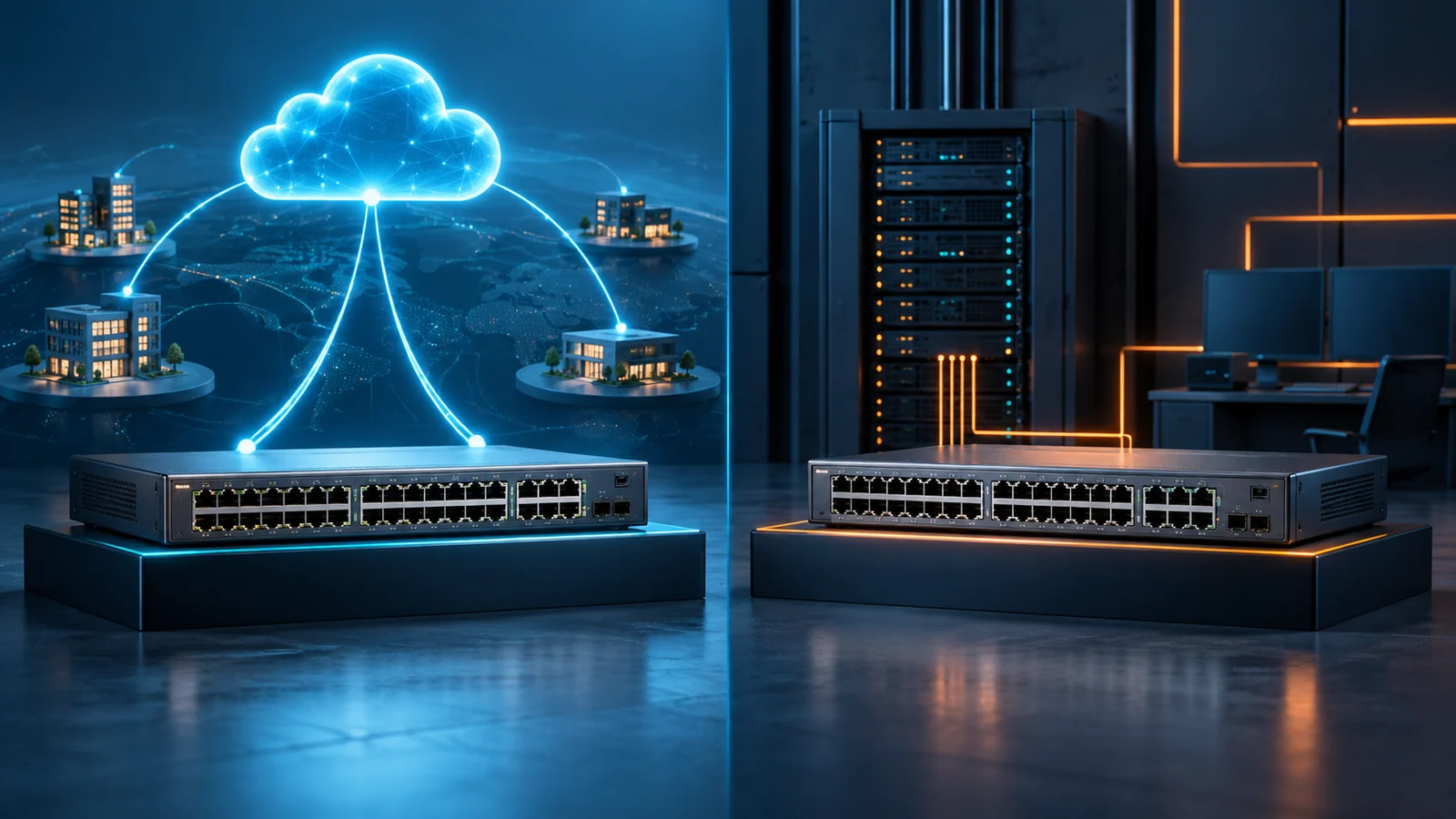
Meraki and Catalyst both come from Cisco, but they solve networking differently - one is cloud-native with subscription licensing built in, the other is CLI-first with optional cloud automation. Here's how the management and cost models actually compare.
Key Points
- Meraki is cloud-native: a single dashboard manages switches, wireless, and security with subscription licensing built in.
- Catalyst runs IOS-XE and is fully functional via CLI on its own, with Catalyst Center as an optional automation layer.
- Catalyst Center can be deployed on-premises or in the cloud, so "Catalyst" doesn't mean on-prem-only management.
- Meraki licensing is a recurring subscription tied to the hardware; Catalyst hardware has no required recurring fee unless you add Catalyst Center tiers.
- Cisco now offers hybrid paths - Meraki-dashboard-managed Catalyst hardware - so the choice isn't strictly either/or.
Cisco sells two very different ways to run the same switch port: a Meraki access switch managed entirely from a cloud dashboard with subscription licensing baked in, or a Catalyst switch running IOS-XE that can be managed by CLI, by Cisco's on-premises or cloud-hosted Catalyst Center, or - increasingly - by the Meraki dashboard itself. The two lines used to represent a clean split between "cloud-managed" and "traditional," but Cisco has spent the last few years blurring that line on purpose. The real decision today is less about which box has better specs and more about which management model and licensing structure fits how your organization actually operates. Here's how the two differ, what each one costs to run over time, and how to decide between them for a new deployment.
Two Approaches to the Same Networking Problem
Meraki was built cloud-native from the start: every Meraki device - switches, access points, security appliances, cameras, and phones - is designed to be configured, monitored, and licensed through a single web dashboard, with no meaningful path to run it purely standalone. That single-pane approach is Meraki's entire value proposition: one login shows you every site, every device type, and every alert across an organization, without needing a separate tool for switches versus wireless versus security.
Catalyst descends from decades of enterprise switching heritage and runs Cisco's IOS-XE operating system, the same lineage that has powered campus networks for years. Its default assumption is the opposite of Meraki's: a Catalyst switch is fully functional and configurable on its own, through a local CLI or SNMP, with no dependency on any external platform. Fleet-wide automation, analytics, and policy are things you can add on top - through Cisco's Catalyst Center - rather than something baked into the switch's basic operation. In practice this means a Catalyst switch keeps working exactly as configured even if every management tool pointed at it disappears; a Meraki switch also keeps forwarding traffic without cloud connectivity, but it was designed assuming the cloud connection is normally there.
Neither approach is objectively "better" - they're built for different operating assumptions. Meraki assumes an IT team (or a managed service provider acting on their behalf) that wants to administer many sites from one browser tab without dispatching a network engineer to each location. Catalyst assumes a team that already has, or wants to build, deep in-house networking expertise and values having every CLI-level control available even if most of it goes unused day to day. Cisco selling both under one roof is precisely why the decision is rarely about hardware capability anymore - modern Catalyst and Meraki access switches cover overlapping port densities, PoE budgets, and throughput tiers - and is instead about which operating model and cost structure matches how the organization is actually staffed and budgeted.
How Meraki's Cloud-Managed Model Works
The Meraki dashboard is a multi-tenant SaaS platform, not something you install. Every switch, access point, or security appliance you add to an organization shows up in the same web interface, and configuration changes are authored in the dashboard and pushed down to hardware rather than typed directly into each device. Because the data plane still lives on the switch itself, a Meraki switch continues forwarding traffic locally even during a WAN or internet outage - what you lose during an outage is the ability to push new configuration changes or see live cloud-side analytics until connectivity returns, not basic switching.
The practical benefits of this model show up most clearly at scale across many sites:
- Zero-touch provisioning. A new switch can be shipped straight to a remote site, plugged in by non-technical staff, and it automatically pulls its assigned configuration from the dashboard the moment it's online.
- Unified visibility. Client-level traffic, application usage, and device health are visible in the same dashboard used for wireless and security, so troubleshooting doesn't require jumping between separate management tools.
- Centralized alerting and firmware. Firmware upgrades, configuration templates, and alert thresholds can be applied across dozens or hundreds of sites from one place instead of device by device.
The tradeoff is that Meraki's depth of low-level protocol customization is intentionally narrower than what a CLI-first platform exposes - the dashboard favors guided configuration and sane defaults over exposing every IOS-style knob, which is a feature for organizations without deep in-house network engineering staff and a limitation for those that want granular control.
Support is also folded into the same model. Rather than tracking a separate SmartNet-style contract per device, Meraki hardware, cloud management, and Cisco support access are tied to the same active license, so a network administrator generally doesn't need to reconcile a hardware warranty against a software support contract against a management platform contract - it's one license covering all three for the term it's purchased.
How Catalyst Management Works
A Catalyst switch is managed the way network engineers have managed enterprise switches for years: a command-line interface over IOS-XE, configurable locally or through common network management tooling, with the full depth of routing, QoS, security, and troubleshooting commands that CLI-based platforms are known for. This is still the model most large enterprise network teams are trained on, and it remains the most flexible option when a deployment needs configuration that doesn't fit neatly into a templated dashboard workflow.
Catalyst Center: On-Premises or Cloud
For fleet-wide automation, assurance, and policy-based segmentation, Cisco layers Catalyst Center (formerly DNA Center) on top of Catalyst hardware. Cisco explicitly offers Catalyst Center as a flexible deployment: it can run on-premises as an appliance, or be hosted in a public cloud, so choosing Catalyst doesn't lock you into on-prem-only management. That flexibility is the core architectural difference from Meraki - Catalyst Center is an optional layer you choose to add and where to run, while the Meraki dashboard is not optional and is not something you host yourself.
This also means a Catalyst deployment can grow into centralized management gradually. A small site can start on CLI-only management with no automation platform at all, and an organization can layer in Catalyst Center later - on-premises if data residency or air-gapped requirements matter, or cloud-hosted if the team would rather not maintain the appliance - once the fleet is large enough to justify it. That staged path doesn't really exist on the Meraki side, where cloud dashboard management is present from the first device onward rather than something added later.
Licensing and Cost Structure Differences
Licensing is where the two platforms diverge most in day-to-day budgeting, and it's the area most likely to surprise a buyer comparing quotes side by side.
Meraki: Subscription Licensing Bundled With Hardware
Meraki devices require an active license to remain manageable in the dashboard, and that license is sold as a term subscription - typically alongside the hardware itself rather than as a separate add-on purchased later. The license is what keeps a device enrolled in cloud management, eligible for firmware updates and dashboard support, and covered under Cisco's licensing terms for that product line. Because the subscription is tied to the term you purchase (commonly multi-year), Meraki costs behave more like a predictable recurring operating expense than a one-time capital purchase - you're budgeting a renewal, not just an upfront hardware line item. If a Meraki license lapses, the switch keeps forwarding existing traffic, but it loses cloud management, support entitlement, and the ability to receive further configuration changes until it's relicensed.
Catalyst: Hardware Plus Optional Subscription Tiers
A Catalyst switch's base MSRP buys hardware that runs IOS-XE and switches packets on its own, with no cloud subscription required just to keep it operating - which is why Catalyst pricing has historically looked more like a traditional one-time (or financed) capital purchase. If you want the automation, network-wide assurance, or SD-Access-style segmentation that Catalyst Center provides, that comes as a separate DNA software subscription, sold in tiers - Essentials for centralized management, provisioning, and secure connectivity, and Advantage for analytics, assurance, and policy-based automation - with an optional Expansion Pack that adds complementary Cisco platforms like Identity Services Engine or Secure Network Analytics. That means a Catalyst deployment's total cost can range from mostly capital expense (hardware only, CLI-managed) to a hybrid capex-plus-opex model once Catalyst Center licensing is layered on top, depending entirely on how much centralized automation you want.
It's also worth knowing that these two licensing worlds aren't as separate as they used to be. Certain Catalyst switch models can be managed through cloud monitoring via the Meraki dashboard instead of - or alongside - Catalyst Center, and Meraki's own switch lineup now includes a Catalyst-9300-based model managed entirely through the Meraki dashboard. In both directions, choosing that path means adopting Meraki-style subscription licensing for that hardware, even though the switch itself is Catalyst-class.
| Factor | Meraki | Catalyst |
|---|---|---|
| Primary management interface | Cloud dashboard (SaaS) | CLI (IOS-XE), optionally Catalyst Center |
| Default management location | Cloud-hosted, not self-hosted | Local/on-box by default; Catalyst Center on-prem or cloud if added |
| Zero-touch provisioning | Built in, core to the platform | Available via Catalyst Center, not a base CLI feature |
| Data plane during an outage | Keeps forwarding; loses new config pushes and live cloud analytics | Keeps forwarding regardless of any management layer's availability |
| Base licensing requirement | Subscription required to stay in cloud management | None required for base switching; add-on for Catalyst Center features |
| Cost model | Predictable recurring subscription (opex-leaning) | One-time hardware cost, optional recurring software tier (capex or hybrid) |
| CLI depth / protocol customization | Narrower, dashboard-guided configuration | Full IOS-XE CLI depth |
| Best fit | Distributed multi-site orgs, limited on-site IT staff | Large campuses, teams wanting deep CLI control or flexible licensing |
The Hybrid Option: Cloud-Managed Catalyst
Cisco has been actively narrowing the gap between these two product lines rather than keeping them as a strict either/or choice. Several Catalyst switch families now support a cloud-monitoring option through the Meraki dashboard, giving teams Catalyst-class hardware with Meraki-style visibility layered on top. Separately, Meraki's own switch portfolio includes a model built on Catalyst 9300 hardware but managed entirely through the Meraki dashboard rather than IOS-XE CLI or Catalyst Center. For an organization that likes Catalyst's hardware performance and feature set but wants the single-pane, cloud-first visibility Meraki is known for, this hybrid path is worth asking a reseller about before assuming it's strictly Meraki-or-Catalyst. The tradeoff is that whichever cloud-management path you pick for that hardware generally brings its associated licensing model along with it.
How to Decide Which Fits Your Organization
- Count your sites, not just your ports. An organization with many small, geographically distributed locations and limited on-site IT staff tends to get the most value from Meraki's zero-touch provisioning and single-dashboard visibility.
- Assess your in-house CLI expertise. A team with experienced network engineers who want granular IOS-XE control, custom routing policies, or protocol-level tuning will often find Catalyst's CLI depth worth the added management overhead.
- Decide how you want to budget it. If predictable recurring operating expense is preferable to capital purchases, Meraki's subscription model lines up naturally; if you'd rather buy hardware outright and add software features only when needed, Catalyst's optional licensing tiers give you that flexibility.
- Check whether you need SD-Access-style segmentation. Advanced, policy-based network segmentation across campus and branch is a Catalyst Center capability - factor its licensing into the comparison if that's a requirement.
- Ask about hybrid options before deciding. Cloud-managed Catalyst hardware may let you keep familiar switching hardware while gaining Meraki-style visibility, so it's worth confirming what a specific model supports before ruling either platform out.
None of these factors work in isolation - a large single-campus deployment with a strong network engineering team but a strict opex-only procurement policy might still lean toward Meraki despite having the staff to run Catalyst CLI comfortably, simply because the budgeting model wins out. Conversely, a distributed retail chain with dozens of small sites might still choose Catalyst hardware managed through Catalyst Center if it already has a large sunk investment in Catalyst switching and licensing from a previous refresh. Treat the list above as inputs to weigh together rather than a strict decision tree, and get a quote for both approaches against your actual site count and feature requirements before committing - the gap between them is usually smaller in practice than the marketing positioning suggests.
Checking Current MSRP
Before comparing total cost between a Meraki and a Catalyst deployment, it helps to see current hardware MSRP for the exact part numbers on the table. Browse the current Cisco switches catalog on GlobalPriceList.com, including Meraki switch part numbers, updated daily so you're working from current pricing rather than an outdated quote.
Related Cisco guides: For recurring cloud costs, read the Meraki licensing guide. For an on-premises design, compare Catalyst 9200, 9300 and 9500 and Cisco DNA license tiers.
Sources
- Cisco Catalyst 9000 Switching Family - Cisco
- Cisco Catalyst Center - Cisco
- Cisco Meraki Switches - Cisco
- Cisco Catalyst 9300 Series Switches - Cisco
FAQ
Is Cisco Meraki cheaper than Catalyst?
It depends on the deployment. Meraki bundles a recurring subscription with the hardware, which behaves like a predictable operating expense. Catalyst hardware has no required recurring fee for base switching, but adding Catalyst Center automation brings its own subscription tiers - so total cost depends on how much centralized management each option needs, not just the switch price.
Can a Cisco Catalyst switch be managed like a Meraki switch?
Some Catalyst models support cloud monitoring through the Meraki dashboard, and Meraki also sells a switch model built on Catalyst 9300 hardware but managed entirely through the Meraki dashboard. It's worth asking a reseller which specific part numbers support this hybrid path.
Does Catalyst Center have to run on-premises?
No. Cisco offers Catalyst Center as either an on-premises appliance or a cloud-hosted deployment, so choosing Catalyst switching hardware doesn't mean you're limited to on-prem-only management.
What happens if a Meraki license expires?
The switch keeps forwarding existing traffic, but it loses cloud management access, dashboard support entitlement, and the ability to receive new configuration changes until the license is renewed.
Check Current Cisco Pricing
Browse the full, daily-updated Cisco GPL on GlobalPriceList.com.
View Cisco Price List