Cisco CW9177 vs CW9179F: Outdoor Wi-Fi 7
Compare Cisco CW9177I, CW9177D, CW9177E, and CW9179F outdoor Wi-Fi 7 access points for campuses, industrial sites, stadiums, antennas, radio capacity, uplinks, power, and licensing.
Key Points
- CW9177 is a purpose-built outdoor Wi-Fi 7 family with omnidirectional, directional, and external-antenna models for campuses, industrial sites, yards, and smart-city deployments.
- CW9179F is the higher-density large-public-venue platform, designed for stadiums, arenas, airports, and similar environments that need flexible beam patterns.
- CW9177 provides up to 12 spatial streams and an 18 Gbps aggregate PHY rate; CW9179F can use four radios and reach up to 24 Gbps aggregate PHY rate.
- CW9177 includes one multigigabit 10G copper interface plus one 1/10G SFP+ interface; CW9179F provides two multigigabit 10G copper interfaces.
- Both platforms use unified hardware and Cisco Networking Subscription licensing for on-premises Catalyst or cloud-managed Meraki operation.
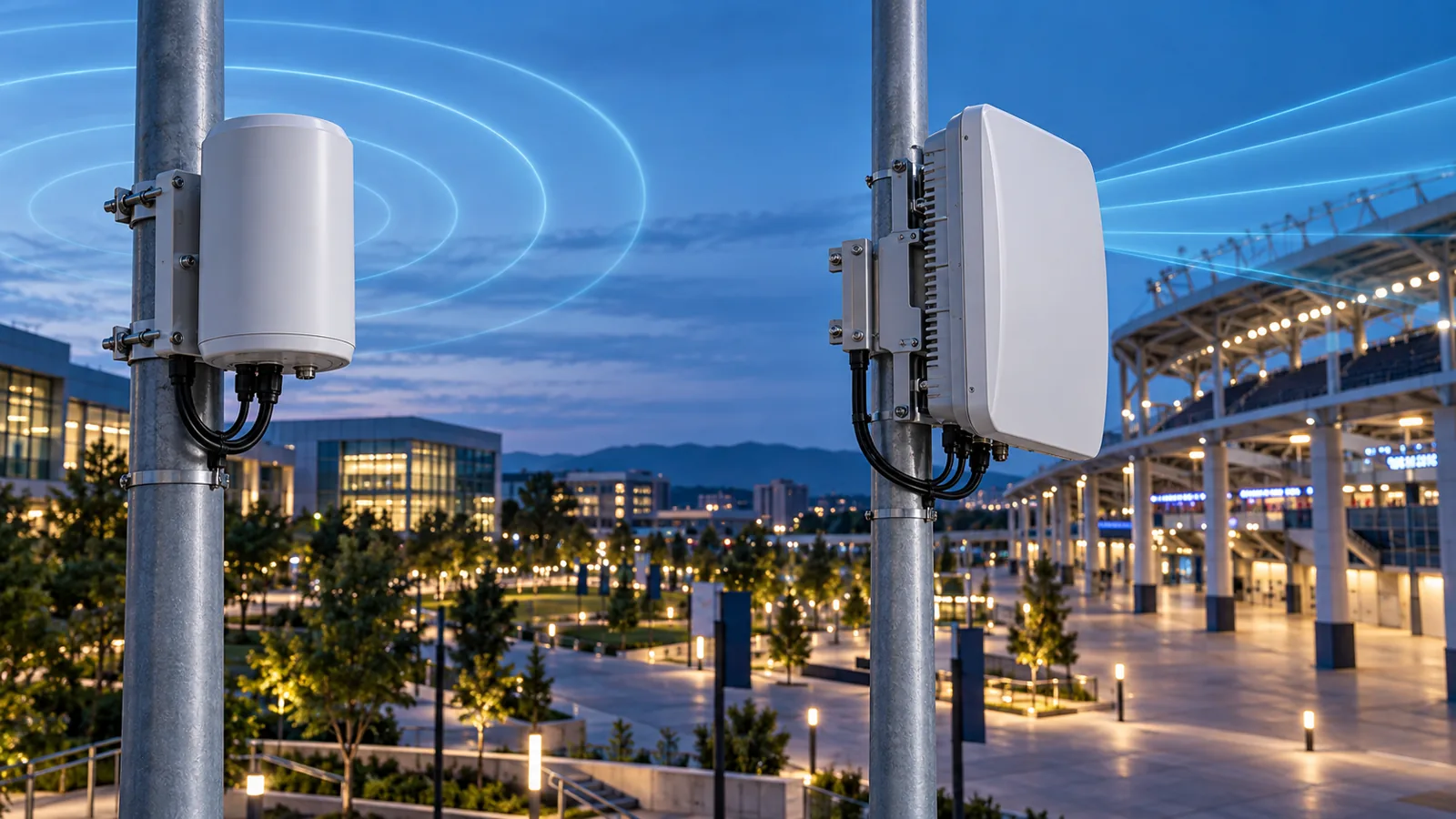
Cisco's outdoor Wi-Fi 7 portfolio now covers two different design problems. The CW9177 Series extends enterprise wireless across campuses, industrial yards, ports, rail environments, and smart-city spaces with three antenna choices. The CW9179F targets high-density large public venues such as stadiums, arenas, airports, and festivals, where capacity and precise RF patterns matter as much as broad coverage.
These access points should not be selected by the larger model number alone. A CW9177I can be the better device for general outdoor coverage, while a CW9179F can be the correct answer for a crowded seating bowl and an unnecessarily complex choice for an ordinary courtyard. The RF design, mounting position, client density, cable path, local 6 GHz rules, switch ports, PoE source, and management platform all belong in the decision.
Quick Answer: CW9177 or CW9179F?
Choose CW9177I when the goal is broad outdoor coverage from an integrated omnidirectional antenna. It fits open campus areas, courtyards, walkways, and similar spaces where clients surround or pass around the mounting point.
Choose CW9177D when coverage should be focused in a direction, such as down a yard, along a platform, toward a building face, or across a defined outdoor zone. Choose CW9177E when the RF design requires an external antenna selected for a specific pattern or mounting constraint.
Choose CW9179F for large public venues with dense crowds and more demanding capacity engineering. Its four-radio architecture, software-configurable coverage options, and dual 10G multigigabit Ethernet interfaces are designed for venue deployments rather than simple blanket coverage.
Cisco CW9177 vs CW9179F Comparison
| Feature | CW9177 Series | CW9179F |
|---|---|---|
| Primary deployment | Outdoor campus, industrial, transport, smart city | High-density large public venues |
| Models / antenna approach | I: internal omni; D: internal directional; E: external antenna | Flexible venue-focused antenna and beam options |
| Radio architecture | Tri-radio, tri-band | Up to quad-radio operation |
| Maximum spatial streams | Up to 12 | Up to 16 across four radios |
| Maximum aggregate PHY rate | Up to 18 Gbps | Up to 24 Gbps in quad-radio mode |
| Wired interfaces | 1 x 100M/1G/2.5G/5G/10G RJ-45 + 1 x 1/10G SFP+ | 2 x 100M/1G/2.5G/5G/10G RJ-45 |
| Outdoor protection | Purpose-built IP67 platform | Indoor/outdoor convertible with the required outdoor environment components |
| Management | Unified hardware for Catalyst on-premises or Meraki cloud management | |
PHY rate is a theoretical radio-layer figure, not application throughput. Real client performance is lower and depends on channel plan, channel width, spectrum availability, interference, client capability, distance, retransmissions, airtime contention, Ethernet uplink, and the services enabled on the access point.
Cisco Wireless 9177 Series: Three Outdoor Coverage Choices
The 9177 Series uses a tri-radio architecture across 2.4 GHz, 5 GHz, and 6 GHz, with an alternate mode that can operate 2.4 GHz plus two 5 GHz radios. Cisco lists 4x4 operation on each serving radio, up to 12 spatial streams, Wi-Fi 7 features including 4096-QAM, Multi-Link Operation, preamble puncturing, uplink/downlink OFDMA, and channels up to 320 MHz in 6 GHz where local regulation and the channel plan allow.
The outdoor chassis carries an IP67 rating and is designed for demanding conditions. Integrated GNSS/GPS supports location-aware functions and Automated Frequency Coordination. A dedicated scanning radio with CleanAir Pro helps identify and classify interference across the serving bands, while integrated BLE supports location-based use cases. Cisco also lists Ultra-Reliable Wireless Backhaul capability for mobile assets or places where running fiber is impractical.
The three models share the platform but solve different RF problems:
- CW9177I: Internal omnidirectional antennas for broad coverage around the access point.
- CW9177D: Internal directional antennas with a focused pattern for defined outdoor zones.
- CW9177E: External antenna connectors for designs that need a separately selected antenna pattern.
Using the same access-point family across these positions can simplify software, licensing, spares, and operational training while still letting the RF design use different antenna patterns. The correct model must be chosen during survey and design; replacing an omni unit with a directional unit later can change coverage and interference far beyond the mounting point.
Cisco CW9179F: High-Density Venue Wi-Fi 7
The CW9179F is designed specifically for large public venues. In quad-radio Wi-Fi 7 mode it can operate 4x4 on 2.4 GHz, two separate 4x4 5 GHz radios, and 4x4 on 6 GHz, for up to 16 spatial streams and a published aggregate PHY rate of up to 24 Gbps. It can also use tri-radio combinations when that better fits the available spectrum and RF plan.
That extra 5 GHz radio is important in venues because a large installed base still depends on 5 GHz even as 6 GHz adoption grows. More radios do not automatically create more usable capacity: channel reuse, antenna pattern, seating geometry, co-channel contention, and client distribution decide whether the design benefits from the added radio.
Cisco describes the CW9179F as convertible between indoor and outdoor use, with multiple beam patterns and configurations. Outdoor installation requires the correct environment pack and supported mounting, cabling, sealing, and antenna configuration. Those accessories are part of the deployment, not optional details to resolve after the APs arrive.
The device provides two 10G-capable multigigabit copper interfaces. Dual interfaces can support deployment flexibility and resiliency designs, but the exact supported behavior depends on controller mode, software release, switching design, and configuration. Validate link aggregation, power, redundancy, and feature support rather than assuming that two physical ports double application throughput.
Antennas and Coverage: The Deciding Difference
Outdoor wireless succeeds or fails on antenna pattern and placement. An omnidirectional antenna distributes energy broadly around its mounting point and is useful when users approach from several directions. A directional antenna concentrates energy into a defined area, improving the ability to cover a path, yard, facade, or seating section while reducing unnecessary radiation behind the AP.
CW9177I is the default candidate for general outdoor cells. CW9177D is more appropriate when coverage has a clear direction. CW9177E supports external Cisco antennas for specialized patterns and mounting needs. Cisco lists tri-band directional and omnidirectional options for the external model, but antenna selection must include supported cable assemblies, connector count, gain, regulatory limits, wind loading, and mounting hardware.
CW9179F belongs in a different density class. Venue Wi-Fi often uses carefully shaped cells to reuse channels across adjacent seating blocks and control which clients hear which AP. The flexible beam approach helps one hardware platform cover multiple venue positions, but it does not eliminate predictive design and an on-site survey.
Do not estimate AP count from outdoor area alone. Record expected clients by zone, application demand, device mix, dwell time, peak-event concurrency, mounting height, obstructions, weather exposure, and spectrum availability. Capacity can require more APs than raw coverage, especially in a stadium or festival environment.
Radio Capacity and Wired Uplinks
CW9177 can advertise up to 18 Gbps of aggregate PHY rate in its 2.4/5/6 GHz mode. Its wired side provides one copper multigigabit port supporting speeds through 10G and one 1/10G SFP+ interface. That choice is valuable outdoors: some locations are easier to reach with copper and PoE, while longer or electrically challenging paths can favor fiber plus a separate supported power method.
CW9179F's maximum published aggregate PHY rate reaches 24 Gbps in quad-radio mode, and the AP has two multigigabit copper ports capable of 10G. In practice, an access switch must provide the required port speed, power class, VLANs, quality of service, and upstream capacity. A 1G switch port can become a wired bottleneck even when wireless signal looks excellent.
Size uplinks from realistic aggregate traffic rather than PHY totals. Most client populations will not sustain the maximum rate across every radio at once. At the same time, installing a premium Wi-Fi 7 AP on a permanently constrained 1G edge can waste much of the investment. Review the Catalyst 1200, 1300, and 1300X switch comparison when selecting a branch access layer for multigigabit and PoE requirements.
Outdoor 6 GHz and Automated Frequency Coordination
6 GHz can provide wider channels and cleaner spectrum for compatible clients, but outdoor operation is regulated by country and deployment type. Automated Frequency Coordination helps standard-power devices identify frequencies and power levels that protect incumbent services. The CW9177's built-in GNSS/GPS supports location information used for AFC and regulatory-domain selection.
AFC availability, permitted channels, transmit power, installation requirements, and controller behavior vary by jurisdiction. A global-use access point does not mean every band and channel is automatically legal everywhere. Confirm the shipping country, installation coordinates, local approval, software release, and cloud connectivity dependencies before designing around outdoor 6 GHz.
Keep a 5 GHz capacity plan even when 6 GHz is available. Not every client supports Wi-Fi 6E or Wi-Fi 7, and some roaming or industrial devices remain on older bands. The CW9179F's second 5 GHz radio can be especially valuable in venues with a mixed client population.
Management and Licensing
Both platforms use Cisco's unified wireless hardware approach. The same AP can be managed on premises with Catalyst 9800 Series wireless controllers or through the Meraki cloud, subject to supported software and onboarding requirements. This reduces the need to buy a different hardware SKU solely because the organization changes management strategy.
Cisco Wi-Fi 7 access points require a Cisco Networking Subscription for wireless, offered in Essentials or Advantage tiers. Select the tier from required features and service level, then keep the subscription term consistent across a comparison. Hardware MSRP without the required subscription and support is not a complete installed-cost figure.
Before migration, verify controller software, AP support, country configuration, feature parity, templates, identity services, monitoring, logging, and operational ownership. “Cloud or on-premises” is a platform capability; it does not make the migration between operating models automatic or risk-free.
Power, Mounting, and Environmental Planning
Outdoor AP orders need more than the access point PID. Mount kits differ by pole, wall, strand, orientation, and articulation. External-antenna deployments need approved antennas and cable assemblies. Fiber deployments need the correct SFP kit and a supported power plan. Weather sealing, grounding, surge protection, cable drip loops, and local electrical rules must be handled in the installation design.
Power the AP from a switch or injector that supports the required IEEE PoE class and budget for the desired radio configuration. Confirm how the AP behaves at lower negotiated power; reduced-power operation can disable or limit radios and features. Include cable loss and distance, and validate that the access switch can deliver the required power on every planned AP port simultaneously.
For CW9179F outdoor use, include the specified environment pack and related accessories. For CW9177, choose among the supported horizontal, vertical, strand, or articulating mounts listed for the exact I, D, or E model. Mount orientation affects both weather protection and RF pattern, so installation teams should receive drawings rather than only a device count.
Which Outdoor Wi-Fi 7 AP Should You Buy?
Campus paths and courtyards: Start with CW9177I for broad coverage. Use CW9177D where the cell should project along a path or toward a specific zone.
Industrial yards, ports, and transport: Evaluate CW9177D or CW9177E based on distance, obstacles, mounting, and required pattern. Consider URWB only after validating the exact mobile or backhaul use case and software support.
External-antenna requirement: Choose CW9177E and build the antenna, cable, mount, grounding, and regulatory calculation as one system. Do not mix unapproved antennas or assume that higher gain is always better.
Stadium, arena, airport, or festival: Evaluate CW9179F where high density, shaped coverage, and additional 5 GHz capacity justify the venue-focused platform. Use a predictive design and validate it with an on-site survey and event-like client load.
Mixed estate: It is reasonable to use CW9177 around the wider campus and CW9179F only in the highest-density venue zones. Unified management and licensing can preserve operational consistency while the RF hardware matches each environment.
Outdoor Wi-Fi 7 Buying Checklist
- Define coverage, capacity, roaming, latency, and availability requirements by zone.
- Choose omnidirectional, directional, external-antenna, or venue beam patterns from an RF design.
- Confirm whether 6 GHz and AFC operation are permitted and available at the location.
- Count 2.4, 5, and 6 GHz clients and keep a plan for legacy devices.
- Validate controller or Meraki support and choose Essentials or Advantage licensing.
- Match 1/2.5/5/10G switch ports and PoE class to the AP configuration.
- Include mounts, environment packs, antennas, cable kits, optics, grounding, and surge protection.
- Perform predictive design, pre-install survey, post-install validation, and capacity testing.
- Document installation coordinates, orientation, height, and photographs for operations.
Checking Current MSRP
Outdoor wireless cost is the complete installed system: AP hardware, subscription, support, mounts, environment components, antennas, cabling, optics, switching, PoE, survey, and labor. Search the Cisco wireless catalog on GlobalPriceList.com by exact product number to establish current hardware MSRP, then normalize every quote around the same licensing term and accessory list.
Related guides: Review the broader Cisco Wi-Fi 6E vs Wi-Fi 7 buying guide, and use the Catalyst 1200 vs 1300 vs 1300X comparison when planning access-switch speed and PoE.
Sources
FAQ
What is the main difference between Cisco CW9177 and CW9179F?
CW9177 is a three-model outdoor family for general, directional, or external-antenna coverage. CW9179F is a higher-density large-public-venue AP with up to four serving radios and flexible venue-focused coverage patterns.
What are the CW9177I, CW9177D, and CW9177E?
CW9177I uses internal omnidirectional antennas, CW9177D uses internal directional antennas, and CW9177E supports external antennas for customized outdoor RF designs.
Can CW9177 and CW9179F use Meraki cloud management?
Yes. Cisco positions both as unified hardware that can operate with supported Catalyst on-premises controllers or Meraki cloud management using Cisco Networking Subscription licensing.
Does outdoor Wi-Fi 7 always use the 6 GHz band?
No. Outdoor 6 GHz availability and AFC requirements depend on local regulations, location, software, and deployment type. A design must also retain adequate 5 GHz capacity for clients that do not support 6 GHz.
Which access switch fits these outdoor Wi-Fi 7 APs?
The switch must provide the required multigigabit speed, PoE class and total power budget. The correct model depends on the AP configuration, number of APs, cable path, uplink capacity, and redundancy design.
Check Current Cisco Pricing
Browse the full, daily-updated Cisco GPL on GlobalPriceList.com.
View Cisco Price List